Basic setup & rules
You will need the following to get started:
Materials needed to get started
| Materials | Quantity(per player) | Optional(Yes/No) |
|---|---|---|
| Chessboard | 1 | No |
| Pawns | 8 | No |
| Rooks | 2 | No |
| Knights | 2 | No |
| Bishops | 2 | No |
| Queen | 1 | No |
| King | 1 | No |
| Chess Clock | 1 | Yes |
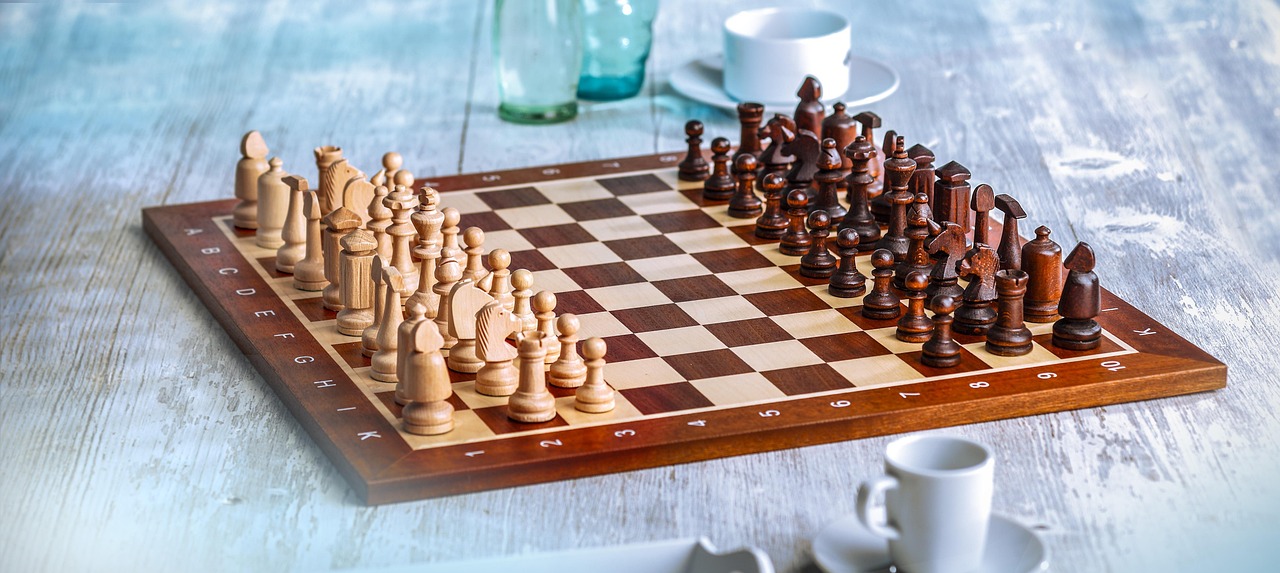
Movesets based on piece value
Each piece on the chessboard can move, but only in specific fashion depending on its value.
- Pawns: may move forward one space (unless they have not already moved, then they can move two spaces if both spaces are empty), but they can only capture pieces by moving diagonally to a square directly adjacent to itself.
- Knights: move in an L-shape direction; they may move two spots vertically or horizontally, and then one spot in the opposite direction; pieces are captured if the Knight's final move lands on an opposing piece
- Bishops: may only move and capture diagonally on the board, but they can move any number of spaces as long as it is open. Once an opposing piece is in their path, they may capture it.
- Rooks: may move forward, in a vertical or horizontal direction for as many spaces that are open. Rooks may capture the first opposing piece in their path.
- Queens: pieces combine the movements of rooks and bishops, so they are free to move vertically, horizontally, and vertically.
- Kings: may move in any direction, but only one square at a time.
Tips for new players
As a beginner, you will have limited knowledge of the game and how to position and strategize properly against your opponent. Some concepts/tips beginners need to understand to play successfully are: control the center of the board, move pieces to strategic locations where they can make the most amount of moves, take your time and be patient, and do not move your queen or king too early in the match.
Simple strategies
There are a few strategies or moves popular amongst all levels of play. A few simple strategies to get you started are as follows: Castling, where one takes a rook and king and moves them simultaneously. The king moves two spaces two the rook while the rook jumps to the spot opposite the king on the board. If you move your king to the right, this is referred to as King-side castling and moving towards the queen is referred to as queen-side castling. Next, it is wise to learn En Passant; this move allows a pawn to be captured if it has made two moves forward, but would have been captured if it had only moved forward one square. Since a pawn can only move two squares forward on its first move, this is typically an early match strategy. Finally, there is the concept of promotion, in which one of the lower value pieces has moved to the end of the board and can now be "promoted" to a different piece, excluding the King piece.
Intermediate/Advanced level strategies
Once a player has become more advanced, it is time to use some higher level concepts. Higher-level chess players often use moves like a sacrifice to eliminate a lower level piece off the board to allow for another higher level piece to make a move in that direction. Other times, it is used to set up a trap on the opponent's piece. Similarly, it is common practice amongst elite players to hone in on a weakness in the opposing teams pieces and suffocate that area so the opponent cannot make any moves. Lastly, elite players will often exploit these weaknesses to set up a "double attack" where the opponent's piece cannot move without being captured by one of the opponent's pieces.